If your doctor has mentioned the angioplasty procedure as a treatment option, it’s natural to have questions. Angioplasty is one of the most common ways to reopen a blocked artery and restore healthy blood flow, often without open-heart surgery. This guide walks you through why it’s done, what happens step by step, and what recovery really looks like.
Table of Contents
ToggleWhat Is Angioplasty?
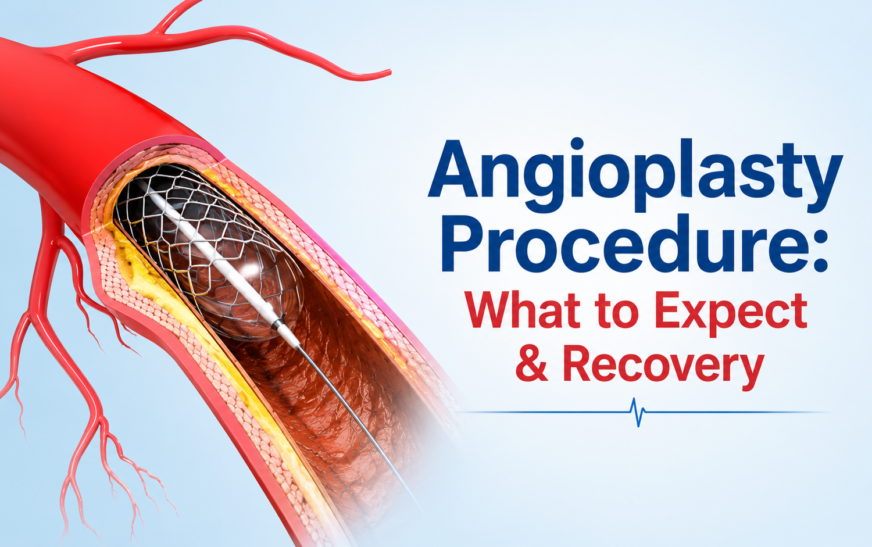
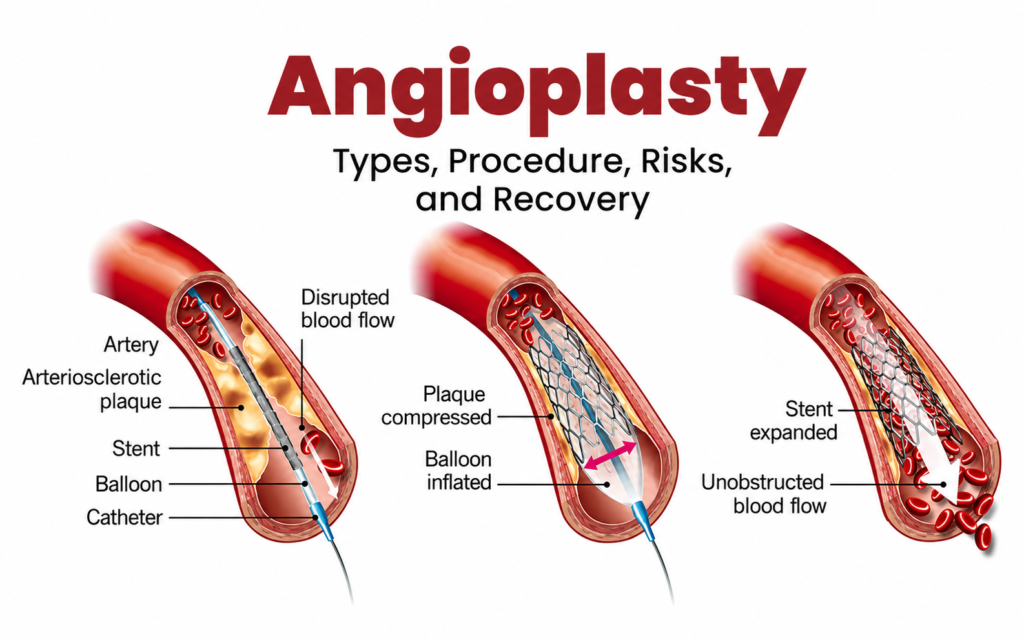
Angioplasty is a minimally invasive procedure that widens an artery narrowed by plaque buildup (atherosclerosis). A thin catheter with a small balloon at its tip is guided to the blocked section of the artery. Once in place, the balloon is inflated to press the plaque against the artery wall, creating more room for blood to flow.
In most cases, a stent, a tiny mesh tube, is left in place after the balloon is removed. The stent acts like scaffolding, holding the artery open and lowering the chance it narrows again.
When performed on the heart’s arteries, this procedure is also called percutaneous coronary intervention (PCI).
Why Angioplasty Is Performed
Doctors typically recommend angioplasty when:
- Chest pain (angina) hasn’t improved with medication or lifestyle changes
- A heart attack is occurring or has just occurred, and quick blood flow restoration is needed
- Imaging tests show a significant blockage in a coronary or peripheral artery
- Surgery (bypass) isn’t the preferred option due to the location or number of blockages
Angioplasty isn’t right for everyone. If several arteries are severely blocked, or the heart muscle is already weakened, a doctor may recommend bypass surgery instead, more on that comparison below.
Types of Angioplasty
Coronary (Balloon) Angioplasty
The most common type, used to treat blockages in the arteries that supply blood to the heart muscle.
Angioplasty With Stent Placement
A stent is inserted after the balloon widens the artery. Most modern stents are drug-eluting, meaning they slowly release medication that helps prevent the artery from re-narrowing.
Peripheral Artery Angioplasty
Used for blockages in arteries outside the heart, commonly the legs, arms, or the carotid arteries in the neck, which can reduce stroke risk.
How to Prepare for Angioplasty
Before a planned (non-emergency) angioplasty, your care team will typically ask you to:
- Share your full medication list, especially blood thinners or aspirin
- Fast for a set number of hours before the procedure
- Arrange for someone to drive you home afterward
- Complete pre-procedure blood tests to check clotting time
- Disclose any implanted devices, such as a pacemaker
What Happens During the Angioplasty Procedure
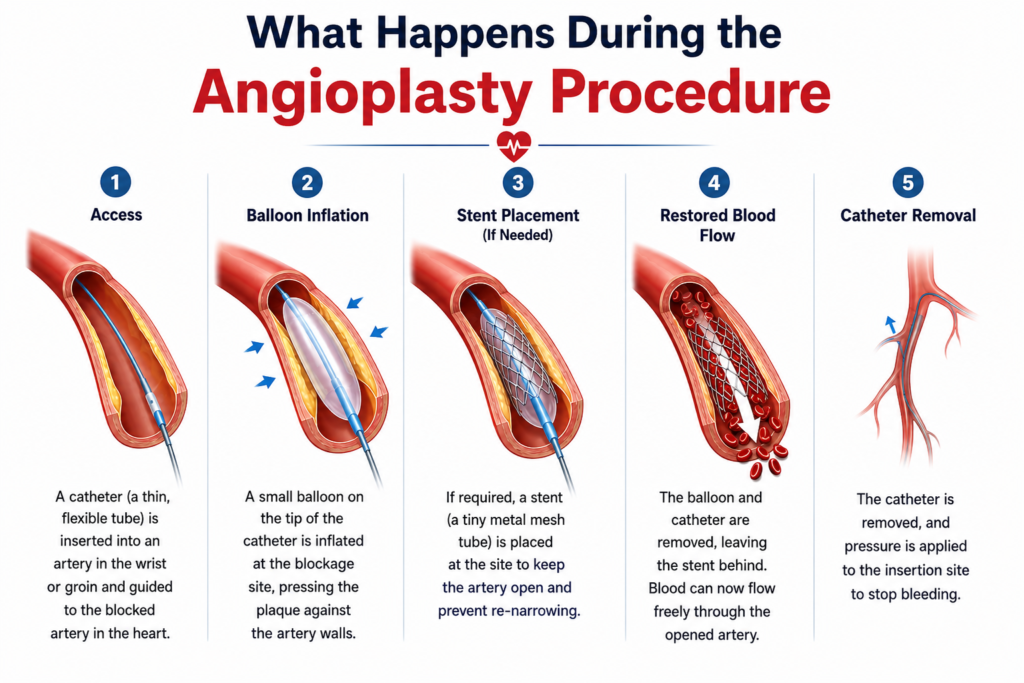
The procedure itself usually takes between 30 minutes and 2 hours, depending on the number and complexity of blockages. Here’s the general sequence:
- Local anesthesia and sedation are given at the catheter insertion site (usually the wrist or groin).
- A catheter is threaded through the blood vessel to the blocked artery, guided by live X-ray imaging (fluoroscopy).
- A contrast dye is injected so the blockage is clearly visible on screen.
- The balloon is inflated at the narrowed section, pressing the plaque against the artery wall.
- A stent is typically placed to keep the artery open.
- The balloon and catheter are removed, and the insertion site is closed and bandaged.
Most people stay awake but relaxed throughout, and some pressure rather than sharp pain is the most common sensation.
Angioplasty Recovery Timeline
| Timeframe | What to Expect |
|---|---|
| First few hours | Monitoring in the recovery area; limited movement of the arm or leg used for catheter access |
| Day 1–2 | Most patients go home within 24 hours (longer if it followed a heart attack) |
| Week 1 | Light activity only; avoid heavy lifting and driving until cleared by your doctor |
| Weeks 2–4 | Gradual return to normal activity; follow-up appointment to check the access site and heart function |
| 3–12 months | Stent becomes fully lined with tissue; continued use of prescribed antiplatelet medication |
Risks and Possible Complications
Angioplasty is generally safe, but as with any procedure involving the arteries, possible risks include:
- Bleeding or bruising at the catheter insertion site
- Blood vessel damage from the catheter
- Blood clot formation
- Re-narrowing of the artery (restenosis)
- Allergic reaction to the contrast dye
- Rare risk of heart attack, stroke, or kidney injury from the dye
Discuss your personal risk factors with your cardiologist, especially if you have diabetes, kidney disease, or multiple blocked vessels.
Angioplasty vs. Bypass Surgery
| Factor | Angioplasty (PCI) | Bypass Surgery (CABG) |
|---|---|---|
| Invasiveness | Minimally invasive, catheter-based | Open-heart surgery |
| Typical recovery | Days to a few weeks | 6–12 weeks |
| Best suited for | Single or fewer accessible blockages | Multiple or complex blockages, weakened heart muscle |
| Anesthesia | Local, with sedation | General anesthesia |
| Hospital stay | Often 1 day (longer if emergency) | Several days |
Your cardiologist will weigh factors like the number of blocked arteries, your overall heart function, and whether you have diabetes before recommending one approach over the other.
Life After Angioplasty: Aftercare Tips
- Take prescribed antiplatelet medication (such as aspirin or clopidogrel) exactly as directed — stopping early raises the risk of stent-related clotting
- Keep the catheter insertion site clean and dry for the first few days
- Watch for warning signs: swelling, unusual bleeding, or chest pain, and contact your doctor if these occur
- Follow up on lifestyle changes: a heart-healthy diet, regular activity as advised, and quitting smoking
- Attend all scheduled follow-up appointments to monitor the stent and heart function
Angioplasty Cost Considerations
Cost varies widely based on your location, hospital, whether a stent is used, and your insurance coverage. Emergency angioplasty (during a heart attack) is typically covered as urgent care under most insurance plans, while elective procedures may involve pre-authorization. It’s worth requesting an itemized cost estimate and confirming coverage details with your insurance provider before a planned procedure.
How long does an angioplasty procedure take?
Most angioplasty procedures take between 30 minutes and 2 hours, depending on how many blockages are treated.
How long is recovery after angioplasty?
Many people return to light activity within a few days and normal routines within 2–4 weeks, though your doctor will confirm a timeline based on your case.
What is the success rate of angioplasty?
Angioplasty has a high success rate for restoring blood flow, though outcomes depend on individual health factors like the number of blockages and overall heart condition.
What's the difference between angioplasty and bypass surgery?
Angioplasty uses a catheter and balloon to open a blocked artery, while bypass surgery reroutes blood flow around the blockage using a graft. Bypass is typically reserved for more complex or multiple blockages.
How much does angioplasty cost?
Cost depends on your location, hospital, insurance plan, and whether a stent is placed. Ask your provider for a written estimate before a planned procedure.